By the numbers
Updated
Independent desk. Figures are traced to named sources and corrections are logged — see the editorial policy.
Every level plays on a field 120 yards long and 53⅓ yards wide. The hash marks, the goal posts and the end zones are where the differences hide.
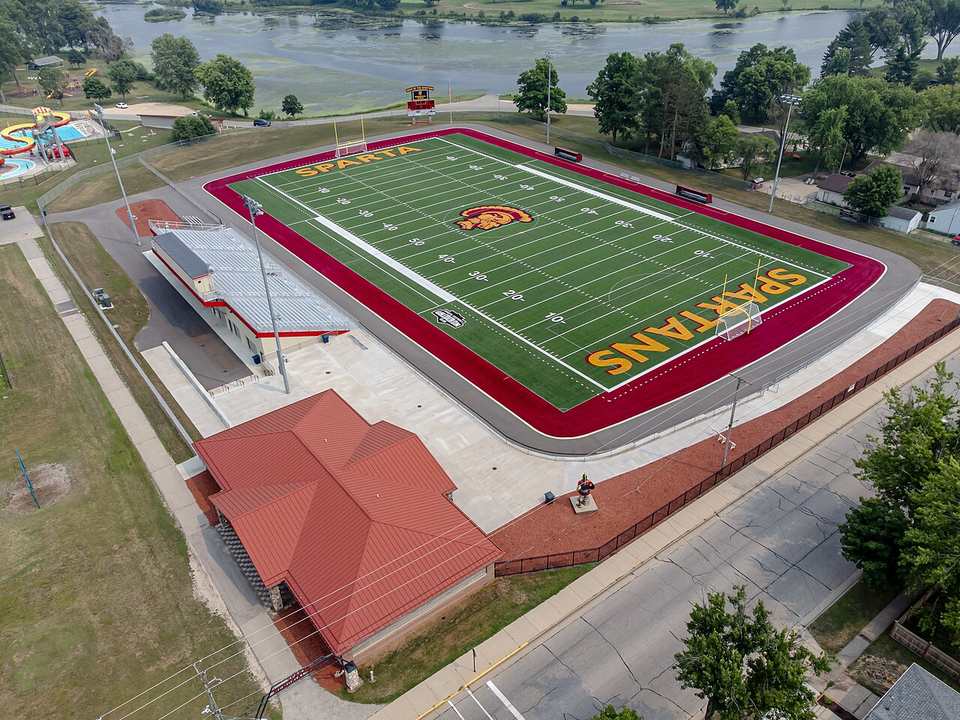

A football field is among the most standardised playing surfaces in sport. The overall rectangle is the same at the NFL, college and high school level. The details that change how the game is played sit inside it.
The shared rectangle
The playing field is 100 yards between the goal lines, with an end zone ten yards deep at each end, for 120 yards overall. The width is 160 feet, or 53⅓ yards. Yard lines are drawn every five yards, with short marks at every yard.
Hash marks: the biggest difference
The hash marks are the short lines that show where the ball is spotted after a play that ends near a sideline. Their distance from the sideline is what separates the levels:
- NFL: 70 feet 9 inches from each sideline, which puts the two rows 18 feet 6 inches apart.
- NCAA: 60 feet from each sideline, so the rows are 40 feet apart.
- High school (NFHS): 53 feet 4 inches from each sideline, which divides the field into thirds.
Narrow NFL hashes mean the ball starts near the middle on most plays and a team has room on both sides. College and high school hashes leave a "short side" of the field, and coaches design plays around it.
Goal posts
The crossbar is ten feet above the ground at every level. The distance between the uprights is 18 feet 6 inches in the NFL and in college, and wider in high school, where it is 23 feet 4 inches. A kicker who moves up from high school to college or the NFL is therefore aiming at a target almost five feet narrower.
Why the width matters more than the length
A field that is 53⅓ yards wide is exactly one-third of 160 feet, which is why the numbers divide cleanly into thirds at the high school level and why hash placement was historically a matter of fractions. The length is the same everywhere; the width is what the game is built around.